In typical karst regions rivers do not dig their course through mountains but underneath them. In southern Slovenia, water flows through a veritable maze that took people long to understand. Already the Romans were puzzled about rivers appearing from out of nowhere in the rocks, meandering only a few kilometers in the open, and disappearing again in caves or sink holes. Water from the Bloke catchment area goes underground and reappears in an underground river in the phantastic Krizna cave. Part of this river appears as the northern branch of the river Obrh. The southern branch of the Obrh comes from a beautiful karst spring at the foot of the Sneznik mountain where a castle of the same name has been built. The two branches unite to from a single river that flows a few kilometres to the northwest and disappears again near the village of Dane. After flowing underneath the mountains that sourround the polje of Cerknica, the river reappears as Strzen, and adds its water to the period lake of Cerknica. Polje means literally "field", it is flat land surrounded by mountains or hills, imagine it as the bottom of a flat bowl. The Cerknica lake was already mentioned by the Greek geographer Strabon. It receives water from the Strzen in the south, the Cerkniscica in the north and sixteen large springs in the lake ground. After the snow melt in spring or, to a lesser extent, after the autumn rains, the lake fills up - sometimes in a single day- and can cover an area of 20 to 30 square kilometres. 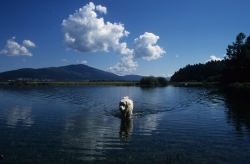 The water level of the Cerknica lake fluctuates 13 m above the lake ground. But underneath ground the water level changes another 20 m, which adds up to a total of water level variation of 33 m. During late spring and summer, the lake water disappears in sink holes and caves - unfortunately for those wanting to swim but a joy for the local farmers who can mow the grass growing on the lake ground after a few months. From the Cerknica lake, the water flows underground to feed the Rak river in Rakov Skocjan.
 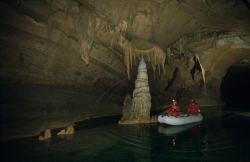 At this site, a former cave has collapsed on a length of 2.5 km and now exposes a real master piece of nature with entrance and exit caves, two natural bridges, karst springs and a lovely sheltered valley with old trees and many flowers. Again, the water disappears and reappears in the vast cave system of Planina.
  The Rak water and water from the Pivka river that comes from the famous caves of Postojna together feed the river Unica. This river meanders in many loops in the polje of Planina until it goes underground again. It reappears in the open as the spring of the river Ljubljanica that flows through the capital of Slovenia. It joins the river Sava near Ljubljana which in turn flows into the Danube. The Slovenian karst region is very close to the Mediterranean and the rivers first flow westwards and seem eager to quickly reach the sea. But then, they "change their mind", make an unexpected loop and transport almost all the karst water far east to the Black Sea.
Web infos karst:


